Blog Post

Hospital Fire Risk Assessment : 8 Key Elements of a Hospital Fire Safety Plan

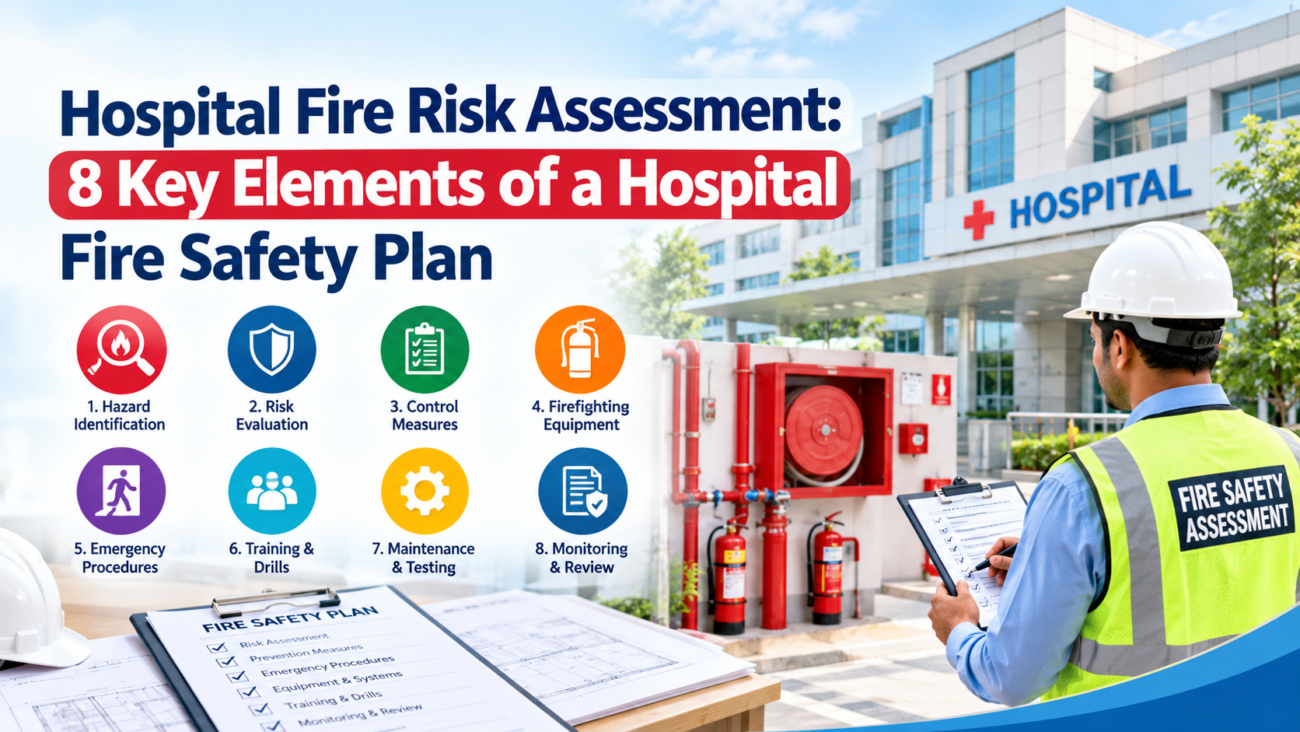
Hospital fire risk assessment showing eight key elements of a hospital fire safety plan

Hospital fire risk assessment is the starting point of fire preparedness, because you cannot protect what you have not assessed. The national guidelines ask every healthcare facility to look at its buildings with a critical eye, on a regular schedule.

Regular hospital fire risk assessment

Every facility must conduct periodic fire hazard assessments for all buildings and units, quarterly or after any major structural or functional change. A Fire Hazard Register should record the hazards found, the corrective action decided and the timeline, along with the electrical categorisation of medical locations.

In addition, a full-scale fire safety audit should be done at least once a year, or as per State or UT norms, with local fire services involved. Independent third-party audits are recommended, and the electrical safety audit should be an integral and high-priority part of them.

The Fire Safety Plan

Each facility must prepare a comprehensive Fire Safety Plan, approved by the Fire Safety Committee and forming part of the hospital’s overall Disaster Management Plan. The suggested components are:

  • Organisational structure with roles of administrators, the Fire Safety Officer, doctors in charge, nursing, security and support staff.
  • Prevention and mitigation measures, including regular maintenance of electrical and gas systems, strict housekeeping to avoid combustible build-up, and fire-retardant furnishings.
  • Detection and suppression systems: alarms, smoke detectors, sprinklers, hydrants and extinguishers.
  • Evacuation planning with floor-wise maps, progressive evacuation and designated assembly points.
  • Emergency response procedures and an incident reporting system.
  • Training and drills, including drills with local fire services.
  • Coordination with the fire brigade, police, disaster management authority, ambulance control rooms and nearby hospitals for patient transfer.
  • Annual review, with updates after major incidents, audits or structural changes, plus a directory of important contacts.

Making the assessment practical

A good assessment is not only a clipboard exercise. Walk through each unit with staff from nursing, engineering and housekeeping, and look for blocked exits, overloaded sockets, stacked cartons, propped-open fire doors, expired extinguishers and missing signage. Photograph what you find, assign a responsible person and a deadline for each item, and close it in the Fire Hazard Register. When a hazard cannot be fixed immediately, record an interim safeguard. Repeating this every quarter builds a habit of attention. It also gives the Fire Safety Committee real evidence for setting budget priorities, because it can show exactly which areas carry the greatest risk and which fixes are complete.

Key takeaways

  • Assess hazards every quarter and after any major change.
  • Keep a Fire Hazard Register with actions and deadlines.
  • Treat ICUs, OTs, gas stores, kitchens, labs and electrical rooms as high-risk.
  • Build the Fire Safety Plan into the hospital’s disaster plan and review it every year.

Frequently Asked Questions on hospital fire risk assessment

How often should a hospital fire risk assessment be done?

Fire hazard assessments should be done quarterly or after any major structural or functional change, and a full fire safety audit should be done at least once a year or as per State or UT norms.

Which hospital areas are considered high-risk?

ICUs, NICUs, HDUs, nurseries, operation theatres, recovery rooms, medical gas stores, LPG kitchens, chemical laboratories, combustible stores, electrical and generator rooms, and battery or server rooms.

What is a Fire Hazard Register?

It is a record of hazards identified, corrective actions decided and timelines, along with the electrical categorisation of medical locations.

What should a hospital Fire Safety Plan include?

A hospital Fire Safety Plan should include fire hazard identification, risk assessment, prevention measures, firefighting equipment, alarm systems, emergency exits, evacuation procedures, staff responsibilities, and patient evacuation arrangements. It should also cover regular fire drills, staff training, equipment inspection, maintenance schedules, emergency communication protocols, and periodic reviews to ensure effective fire safety and regulatory compliance.

Leave a Reply

Your email address will not be published. Required fields are marked *