Blog Post

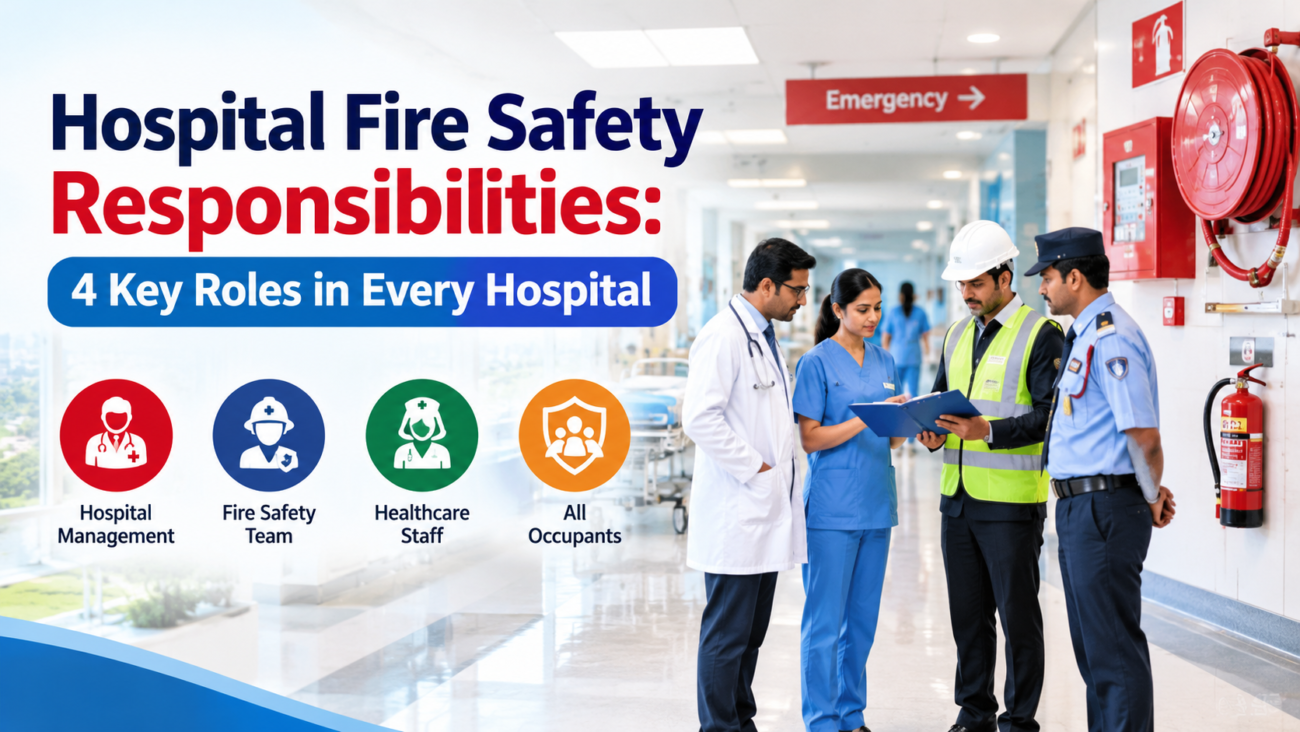
Hospital Fire Safety Responsibilities 4 Key Roles in Every Hospital

Hospital Fire Safety Responsibilities: 4 Key Roles in Every Hospital

Hospital fire safety responsibilities are shared, but each group has a different role. Ask who is responsible for fire safety in a hospital and many people will say, “the fire officer.” The national guidelines give a fuller answer, and knowing who does what is the first step to a safer facility

Hospital administration: ultimate responsibility

The administration holds overall responsibility for compliance with all applicable fire safety laws, codes and guidelines. It should ensure the infrastructure complies with the National Building Code, Fire Service Rules and State fire prevention acts, approve and periodically review the Hospital Fire Safety Plan, facilitate regular audits and certification, and make sure all categories of staff are trained.

The Fire Safety Committee

Every healthcare facility should form a Fire Safety Committee to oversee planning, implementation and monitoring of fire and electrical safety. Members come from administration, engineering and maintenance, nursing, security, housekeeping and clinical departments. The committee reviews the fire safety plan and evacuation plan, oversees risk assessments and recommends corrective actions, coordinates with local fire services, police and disaster management authorities, and reviews the outcome of every mock drill.

Every staff member counts

The guidelines say plainly that fire safety is a shared responsibility. Each staff member must attend fire safety orientation at induction, refresher training, and whenever they move between departments. They should know where the firefighting equipment, electrical isolators and MCBs, area alarms and medical gas valves are, and be aware of the nearest evacuation route and assembly point. Any fire hazard or malfunction, such as an electrical fault or gas leak, must be reported immediately.

Senior nursing officers in charge of wards, ICUs and nurseries carry special responsibility for preventing fires and for the safe evacuation of patients under their care, supported by security and housekeeping staff.

Hospital fire safety responsibilities matrix

The guidelines include a RACI-style matrix. For example, the administration is accountable for approving the fire safety plan and allocating budget, while the FSO is responsible for drafting the plan, maintaining hydrants and alarms, organising drills and keeping records. The Fire Safety Committee leads quarterly fire risk assessments. All staff are responsible for patient evacuation and for reporting hazards. Such clarity avoids the common problem where everyone assumes someone else is looking after safety.

Key takeaways

  • The administration is accountable; the FSO and committee do the planning and monitoring; staff act on the ground.
  • Appoint a trained FSO, and add deputies and fire wardens in larger or high-rise hospitals.
  • Training must be repeated whenever staff change departments.
  • Written, clearly assigned roles prevent confusion in an emergency.

Frequently Asked Questions on hospital fire safety responsibilities

Who is ultimately responsible for fire safety in a hospital?

The hospital administration holds overall responsibility for compliance with fire safety laws, codes and guidelines, including approving the Fire Safety Plan, arranging audits and ensuring staff training.

What does a Fire Safety Committee do?

It reviews and approves the fire safety and evacuation plan, oversees risk assessments, coordinates with the fire brigade, police and disaster management authorities, and reviews the results of mock drills.

Does every hospital need a Fire Safety Officer?

A Fire Safety Officer must be appointed. For high-rise hospitals above 15 metres, the NBC requires a qualified professional with three years of fire safety experience, and the guidelines suggest one for facilities with 250 beds or more.

What are the fire safety duties of ordinary staff?

Hospital staff must attend fire safety training, know emergency exits, escape routes, assembly points, alarms, extinguishers, and relevant gas shut-off valves. They should report hazards immediately, keep evacuation routes clear, raise alarms during emergencies, and assist patients, visitors, and vulnerable occupants with safe evacuation according to hospital emergency procedures.

Leave a Reply

Your email address will not be published. Required fields are marked *