Blog Post

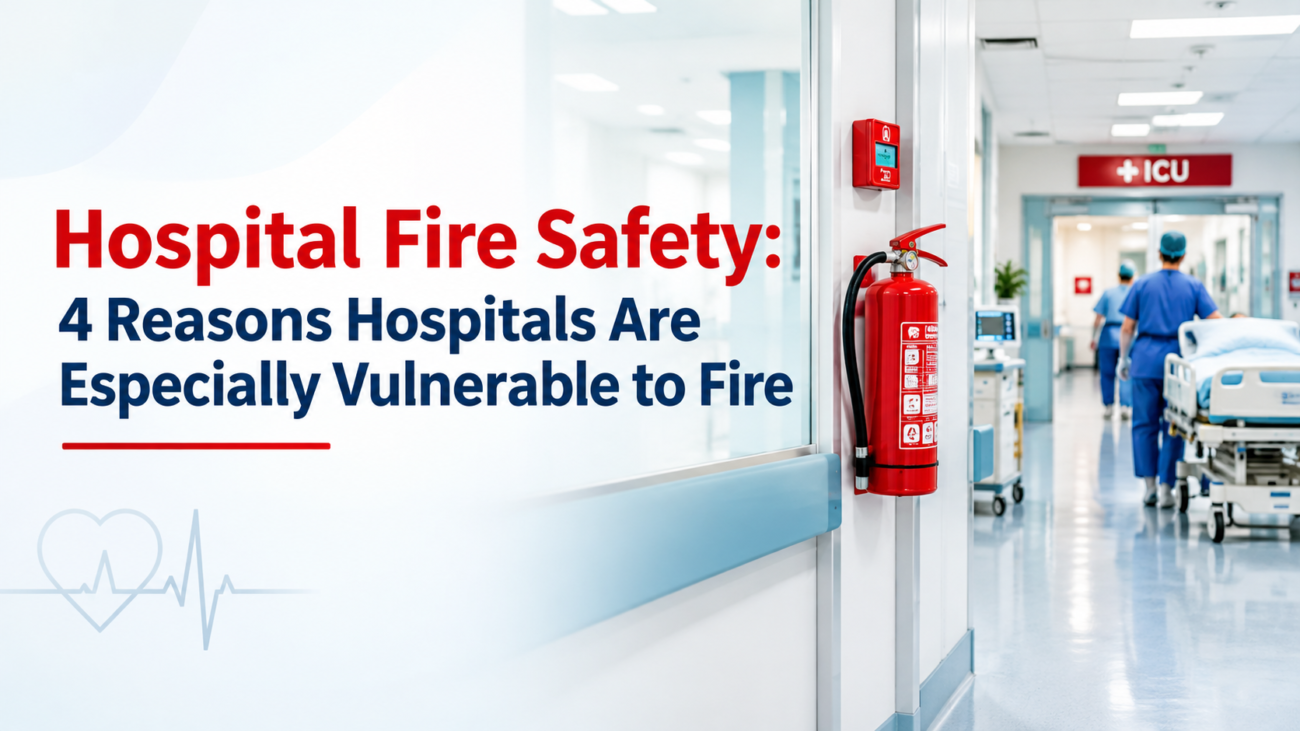
Hospital Fire Safety: 4 Reasons Hospitals Are Especially Vulnerable to Fire

Hospital fire safety with fire extinguisher in a hospital corridor

Hospital fire safety matters more than in almost any other building, because when a fire breaks out in a hospital, many of the people inside cannot walk at all. That is why fire and life safety is treated as a foundational pillar of healthcare facility management in the revised national guidelines issued by the Ministry of Health and Family Welfare (MoHFW).

Why hospital fire safety is different

The guidelines describe healthcare facilities as uniquely vulnerable for four reasons:

• A high concentration of patients with limited mobility, including those in ICUs, operation theatres and nurseries.

• Widespread use of oxygen and other medical gases, which make fires burn faster and harder.

• Complex electrical systems running day and night, from ventilators to air conditioners.

• Storage of combustible materials such as linen, packaging, disposables and chemicals

Small lapses, big consequences

Past fire incidents in India have shown that even a small lapse can end in a catastrophe for patients, staff and infrastructure. Recent studies identify electrical faults as the most common cause of hospital fires in the country, especially short circuits and malfunctioning air conditioners or medical equipment. A smaller share is linked to flammable chemicals, poor storage of combustibles, battery storage devices, and unsafe storage and renovation practices.

The message is clear: most hospital fires are not freak accidents. They start from ordinary problems such as an overloaded socket, a damaged wire or clutter left near a heat source, and they are preventable.

A national framework

MoHFW first issued fire and life safety guidelines for healthcare facilities in 2020, supplementing the National Building Code of India (NBC) 2016, Part 4, and NDMA guidance. The revised edition updates this advice in light of new developments and newer standards, while staying aligned with NBC 2016.

The guidelines are aimed at administrators, engineers, architects and healthcare workers. They apply to institutional buildings under NBC Group C: hospitals, nursing homes, maternity and child-care centres,

sanatoria, rehabilitation centres, psychiatric hospitals and any other facility where patients may be unable to protect themselves in a fire.

Key takeaways

  • Hospitals face higher fire risk because patients cannot always move themselves, oxygen is in use, and electrical loads are heavy.
  • Electrical faults are the leading cause of hospital fires in India.
  • Prevention, life safety and protection must work together.
  • Hospitals must follow both national guidelines and local fire rules.

In the articles that follow, we break down each part of the guidelines in simple language, so that administrators, staff, patients and visitors can all play their part in keeping healthcare spaces safe.

Frequently Asked Questions on hospital fire safety

Why are hospitals more vulnerable to fire than other buildings?

Hospitals have patients with limited mobility, widespread use of oxygen and other medical gases, complex electrical systems running all day, and stored combustible materials. Together these make fires more dangerous and evacuation harder.

What is the most common cause of hospital fires in India?

Electrical faults. The guidelines say short circuits and malfunctioning air conditioners or medical equipment are the predominant cause, with flammable chemicals, poor storage of combustibles, batteries and unsafe renovation practices causing a smaller share.

Are the MoHFW fire safety guidelines mandatory?

The guidelines are advisory and meant to be adapted by States and Union Territories. However, updates to national codes such as NBC, and State, UT or municipal rules, must be followed by all healthcare facilities.

Which facilities do the guidelines apply to?

The guidelines apply to institutional buildings classified under Group C of the National Building Code (NBC) of India. These include hospitals, nursing homes, maternity and child-care centres, sanatoria, rehabilitation centres, and psychiatric hospitals. They aim to ensure appropriate fire safety measures, protect patients and staff, support emergency evacuation, and maintain compliance with applicable fire prevention and safety regulations.

Leave a Reply

Your email address will not be published. Required fields are marked *